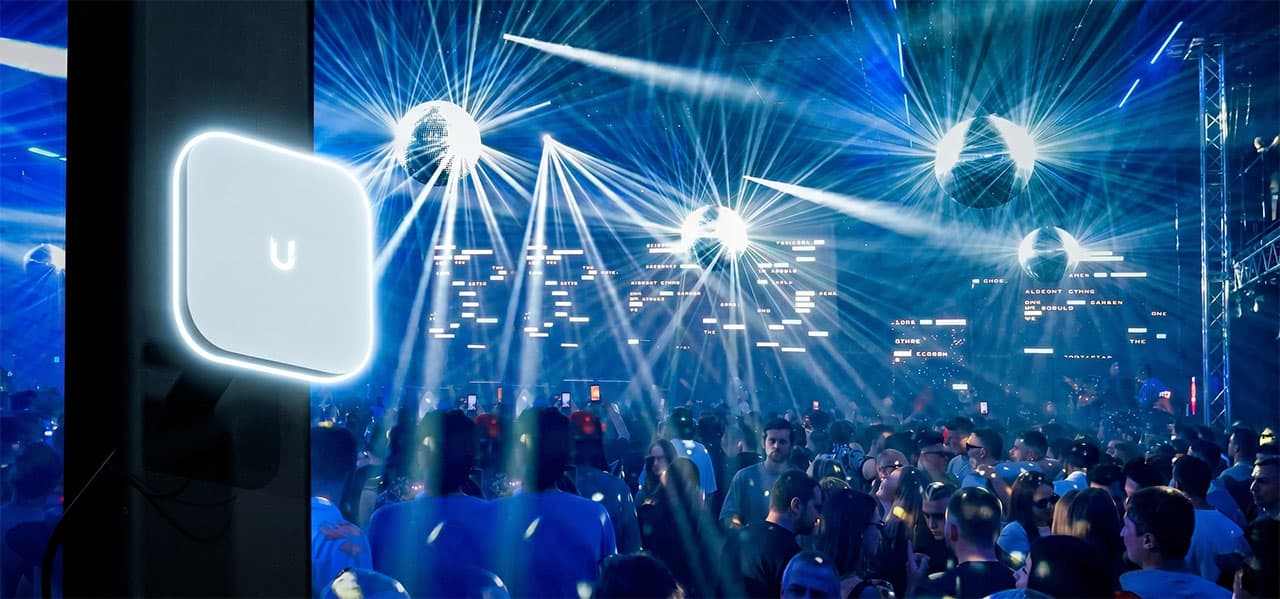
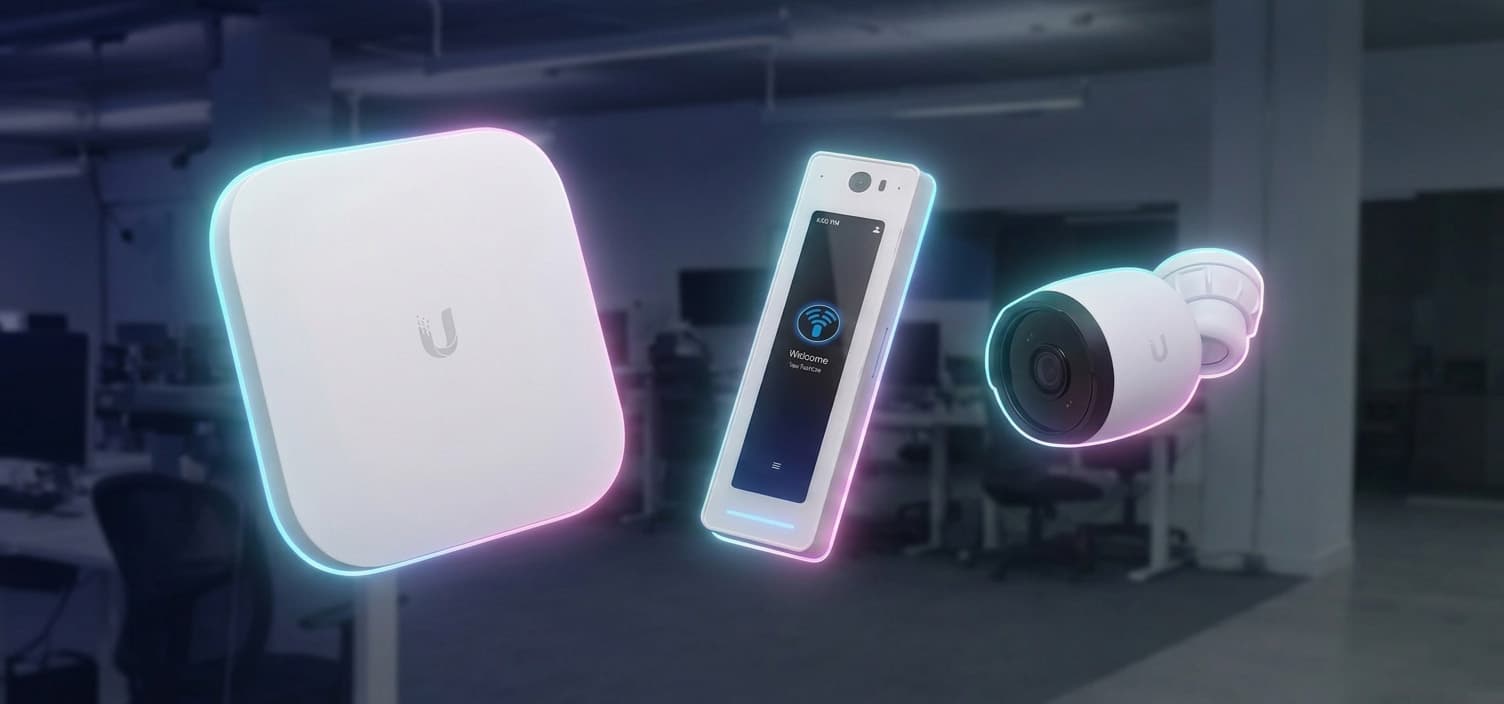
Why UniFi E7 Campus Became Our Go-To Outdoor Access Point
Engineering a stable wireless footprint across expansive open environments presents layout obstacles that indoor environments rarely encounter. Open-air zones completely lack reflective surfaces to propagate signals, exposing devices to direct weather extremes, RF noise floors, and volatile crowd density metrics during commercial event scaling. Most standard outdoor hardware platforms either drop packets entirely under heavy user loads or demand excessive device nesting to maintain basic cell edge coverage.
This operational limitation shifted entirely with the launch of the UniFi E7 Campus (E7-Campus). This enterprise-grade, tri-band WiFi 7 radio architecture integrates 10 spatial streams with a native 10 GbE uplink interface, positioning it in a distinct performance class for demanding enterprise perimeters.
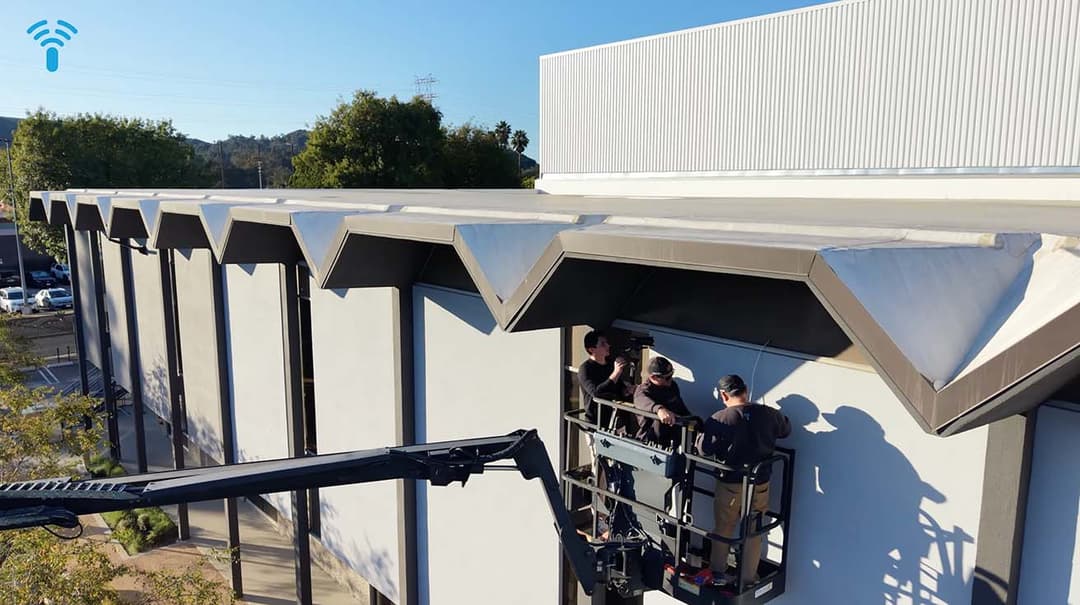
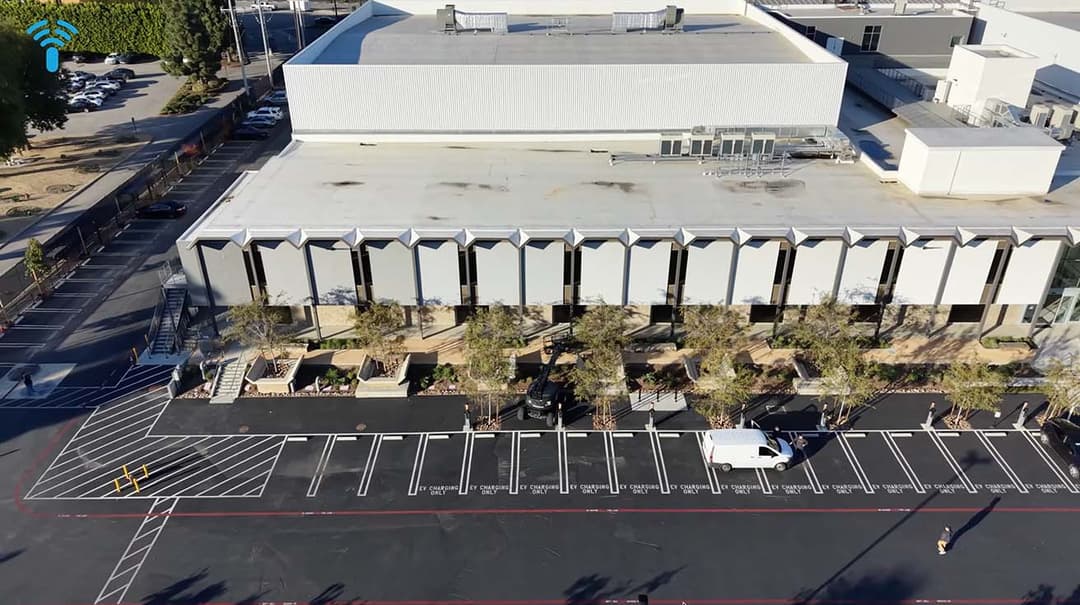
During an infrastructure deployment for BlueGround Studios in Los Angeles, our technical field team put the E7 Campus through an extensive field validation inside a challenging RF layout: a wide-open commercial studio parking lot that doubles as a high-density outdoor event venue. The field data gathered on-site reshaped our engineering approach for long-range wifi installation configurations.
Project at a Glance
Site Overview
- Location & Client: BlueGround Studios, Los Angeles, CA
- Industry Vertical: Commercial Entertainment & Production Event Space
- Project Scope: High-Density Outdoor Wireless Infrastructure Design
Network & Backbone Infrastructure
- Core Backhaul Link: 10 GbE Distributed SFP+ Core Interface Switching
- Upstream Service Provider: 1 Gbps Dedicated AT&T Circuit (Provisioned for 5–10 Gbps Scaling)
- Power Delivery Protocol: Centralized PoE++ (802.3bt) Switch Allocation
Wireless Hardware & Performance Metrics
- Primary Access Nodes: UniFi E7 Campus WiFi 7 Access Points
- Radio Engineering: Tri-Band Matrix featuring 10 Isolated Spatial Streams
- Validated Range Radius: 300–400 Feet Open Area Connectivity Footprint
- Real-Time Link Latency: 5 Milliseconds Flat Across Active Cell Grid
- Concurrence Load Capacity: Up to 1,000 Active Client Profiles per Node
Background and Site Demands
The BlueGround Studios enterprise lot functions as a multi-use footprint. During production schedules, the asset serves as a standard automotive pool, but transitions rapidly into a high-capacity event space during seasonal scheduling. These events demand stable network access for payment gateways, administrative teams, incoming media crews, and hundreds of concurrent visitors.
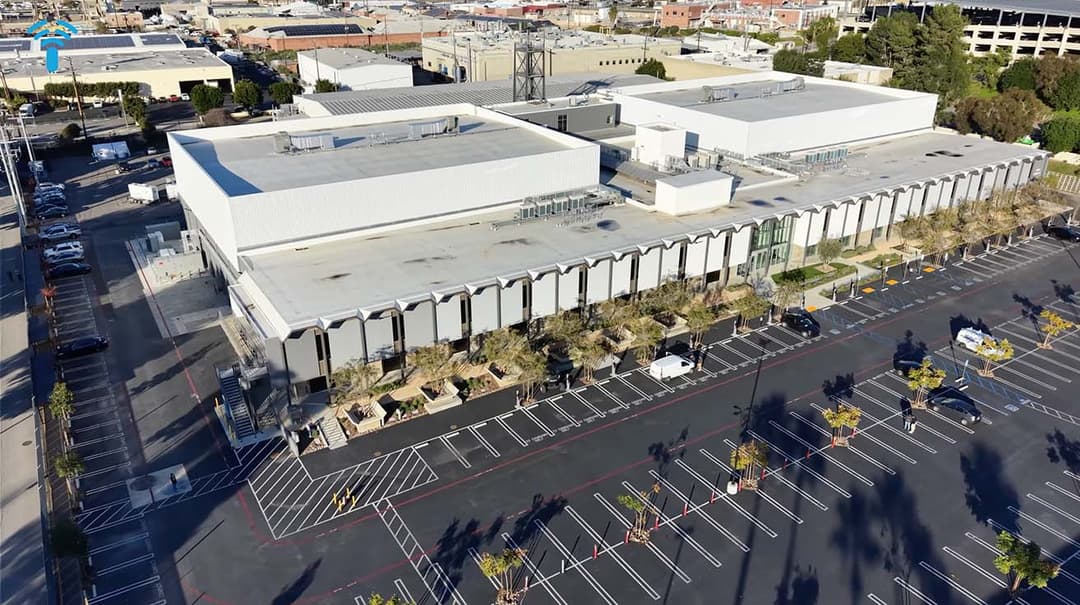
Covering an open perimeter appears elementary on paper, but engineering history across complex cold-storage facilities proves that open-air spaces quickly degrade weak hardware designs. Without physical walls to deflect and focus radio waves, signal consistency depends entirely on the node's baseline transmission power, antenna engineering, and receiver sensitivity. The moment hundreds of mobile devices crowd the spectrum, standard prosumer hardware drops packets due to channel congestion. We required an enterprise-grade node that could handle extreme link distances, isolate client traffic, survive weather metrics, and integrate cleanly into a centrally managed network framework.
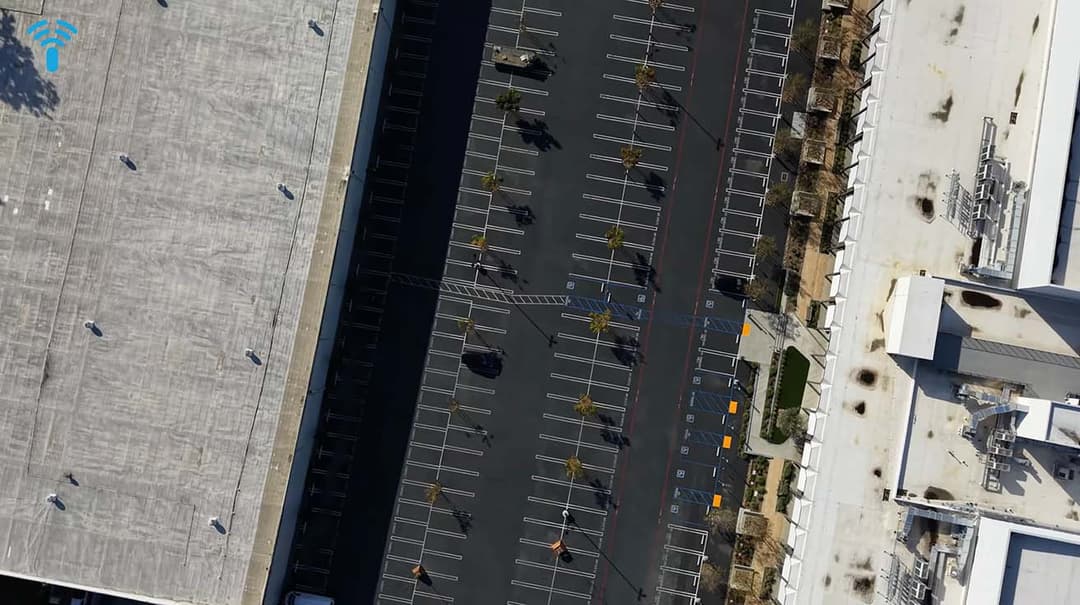
Initial Planning: The Four Access Point Assumption
Our initial deployment blueprint followed standard low-voltage conventions, assuming we would need four separate UniFi E7 Campus units to establish adequate coverage limits across the lot perimeter. The layout template positioned one node on each structural corner: two units flat-mounted to the main building facade, one adjacent to the security entry checkpoint, and a fourth pole-mounted at the outer edge of the property line to prevent dead zones.
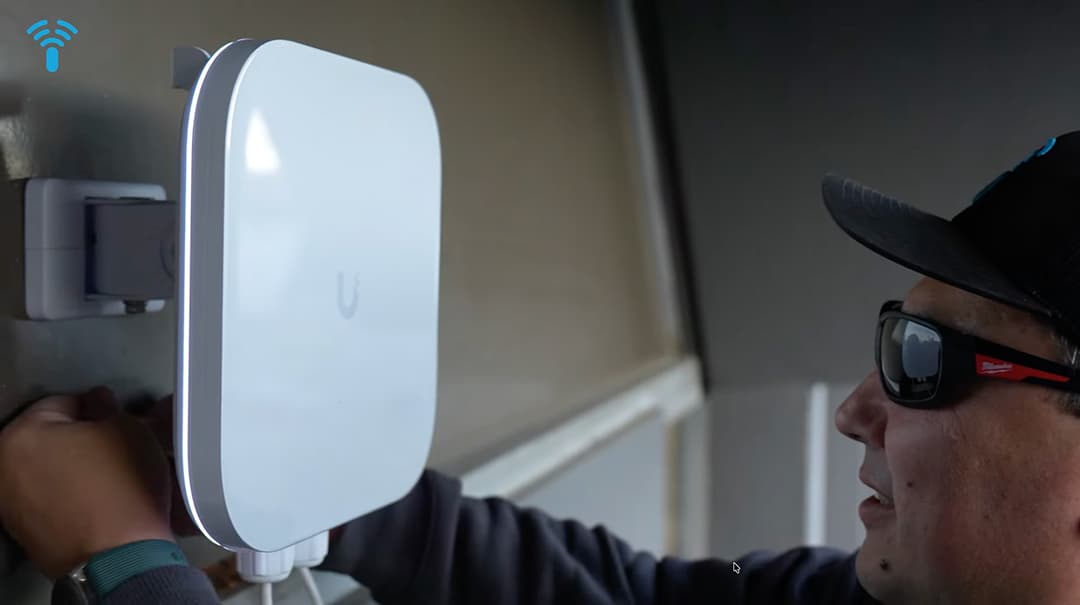
We initiated the field deployment by mounting and wiring the first two units on the west building wing. Our strategy was to boot the initial link to measure cell metrics before running conduit to the secondary pole positions. However, the moment the first west node came online, our diagnostic telemetry recorded signal propagation limits that completely challenged standard cell assumptions.
Live Testing: One Access Point, Full Coverage
With only one West-facing E7 Campus node active, our team walked the entire parking lot footprint while logging connection properties, link latency, and aggregate throughput using wireless analysis tools. The field metrics outpaced standard product datasheets.
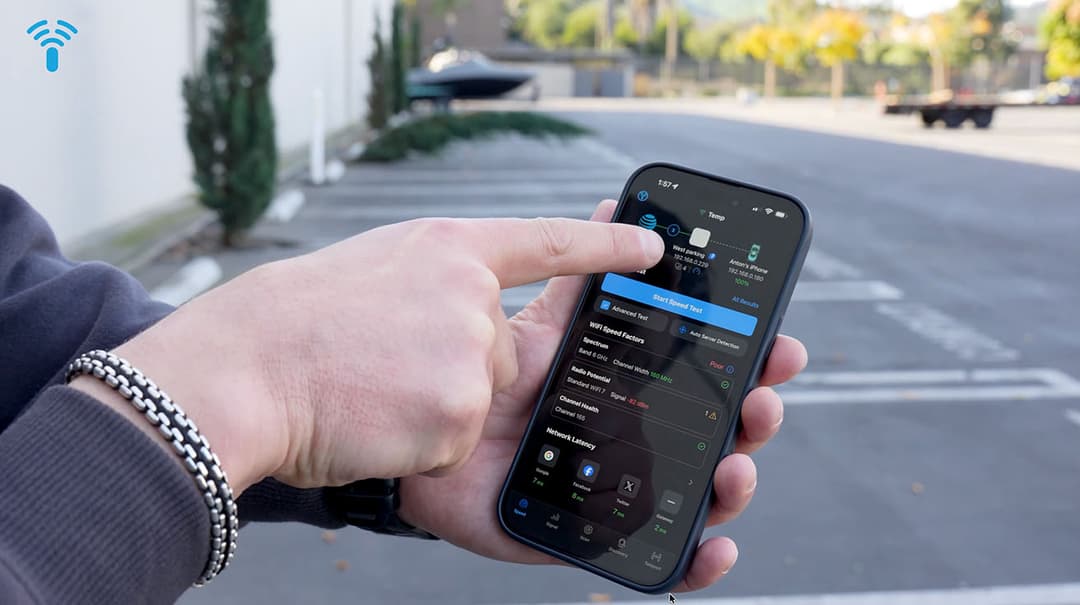
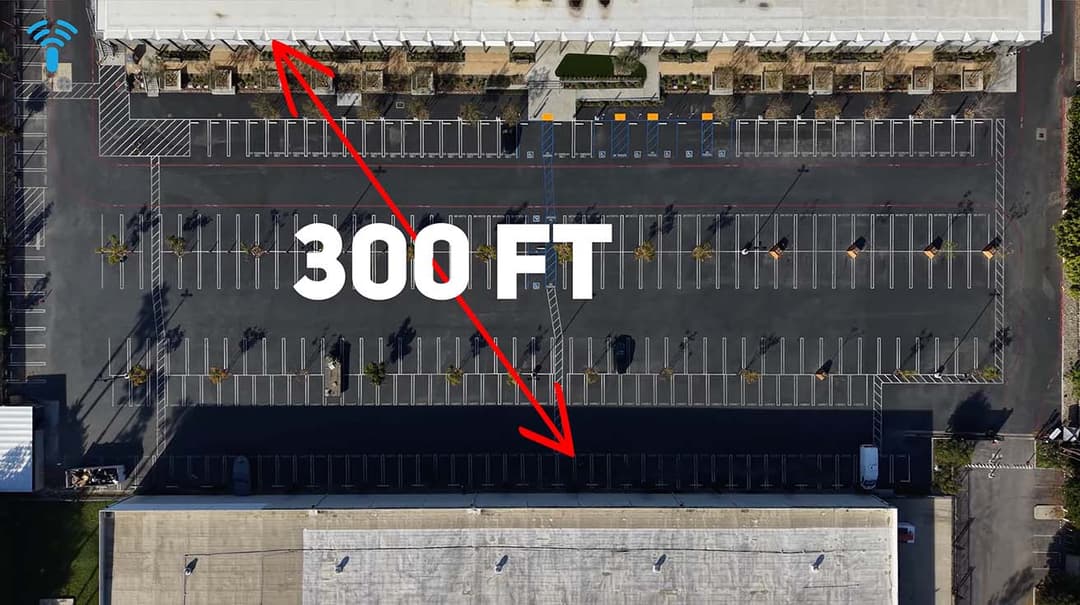
Standing at a distance of 300 to 400 feet from the physical building fascia, our testing tools logged a flat, consistent latency of 5 milliseconds. The signal strength remained high enough to completely saturate the 1 Gbps AT&T circuit temporarily servicing the studio. This test was executed in real-world midday conditions with active vehicular blockages, not inside a shielded laboratory setting.
The performance of the E7 Campus relies on specific proprietary radio technologies:
- PRISM RF Filtering: This hardware layer isolates the operating channels, blocking environmental noise and adjacent network interference from neighboring city properties.
- Focused Directional Antennas: The antenna arrays on the 5 GHz and 6 GHz spectrum bands direct signal energy directly toward the target field rather than wasting output power skyward.
- Multi-Link Operation (MLO): As a native WiFi 7 feature, MLO allows client devices to send and receive data across multiple frequency bands concurrently, ensuring exceptional link stability even at extreme distances.
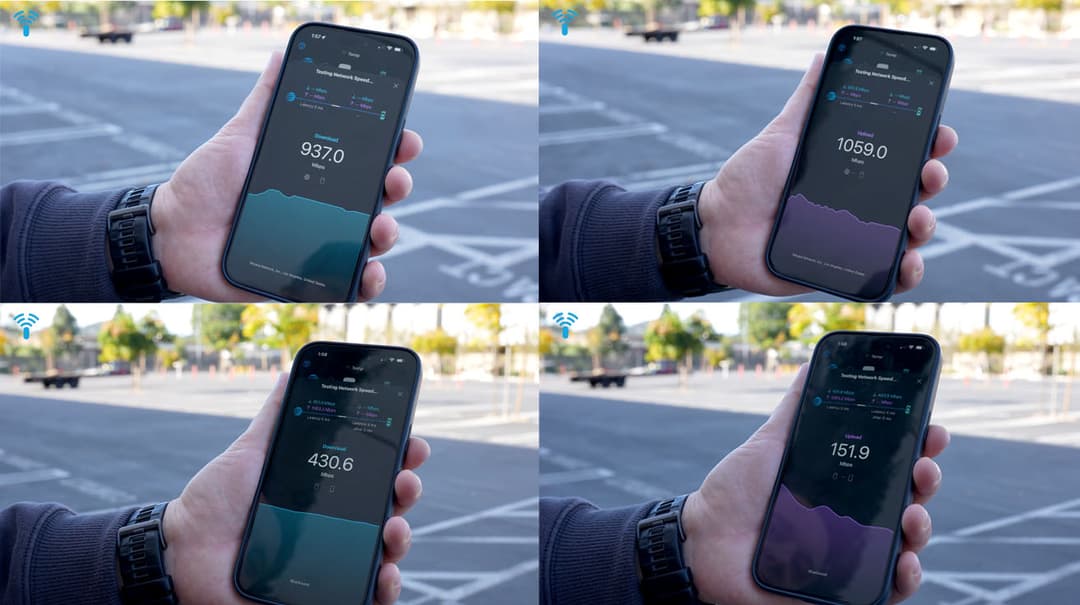
We repeated these measurements across the furthest property boundary lines where the secondary pole mounts were originally slated. The data stream remained stable, latency held flat, and throughput metrics did not drop, proving that the original four-unit design was an unneeded expenditure. The E7 Campus successfully managed a coverage zone that traditionally requires double the hardware footprint.
Infrastructure Design: Building for 10 Gbps Backhaul
Although the current active internet link runs on a 1 Gbps AT&T circuit, BlueGround Studios is scheduled to upgrade the facility to a 5–10 Gbps fiber circuit as venue booking metrics scale. Our engineering team designed the underlying low-voltage switching backbone to handle this future data state without requiring physical modifications.
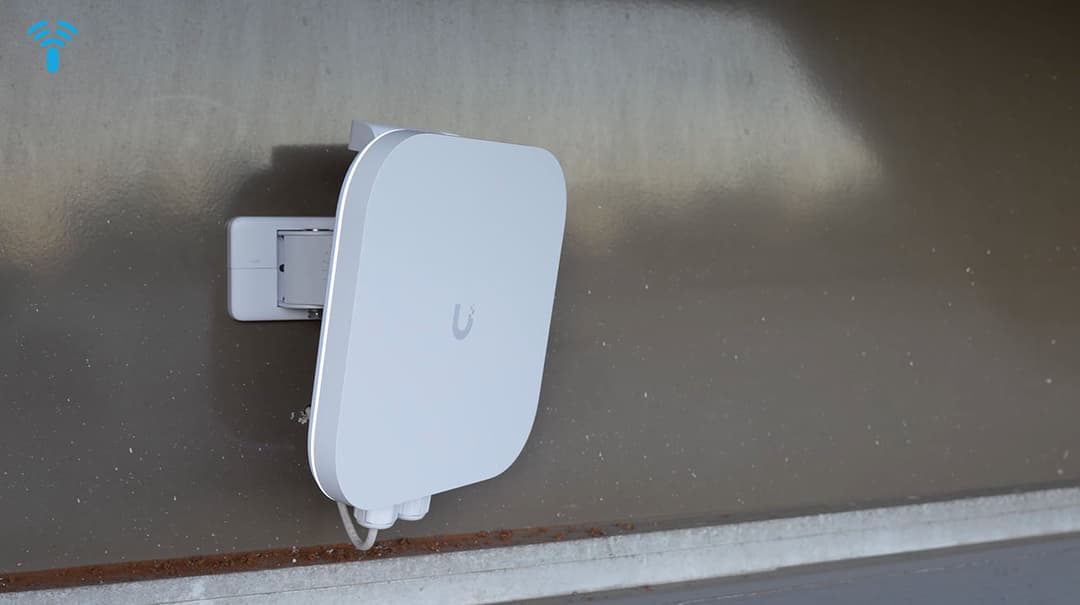
The E7 Campus is engineered with a native 10 GbE RJ45 interface, ensuring the radio can ingest multi-gigabit backhaul streams without bottlenecking at the physical port level. Every access node connects directly to a 10 Gbps network core switch. When the upgraded internet circuit drops into the server room, the wireless network will accommodate the speed increase instantly. Power delivery is handled by centralized PoE++ (802.3bt) switches, allowing data and high-wattage power to travel down one single CAT6A line, which drops point-of-failure metrics across the property.
Building long-term operational headroom into initial topologies is a strategy we prioritize across all major industrial sites. We deployed the same infrastructure safeguards during our high-security logistical warehouse upgrade, preventing future network teardowns when bandwidth needs scale past initial estimates.
Revised Design: Two Access Points Instead of Four
Based on our verified field data, we modified the project plan. Instead of four outdoor units, the finalized blueprint uses just two E7 Campus access points to run the primary parking lot footprint, with a third unit positioned on the structural rooftop to cover an isolated upper deck space.
blueground/UniFi_E7_Campus.jpg
Dropping the hardware count by 50 percent delivers clear advantages beyond initial equipment cost reduction:
- Simplified Channel Layouts: Fewer active radios minimize co-channel interference and keep the airwaves clean.
- Fewer Failure Points: Consolidating nodes minimizes the physical cabling runs, connectors, and switch ports that require maintenance.
- Smarter Load Distribution: With each unit rated to handle 1,000 active clients, the two primary parking lot nodes deliver 2,000 client slots, providing an exceptional capacity buffer for packed festival schedules.
Comparison with Legacy Outdoor Hardware
Our low-voltage teams have deployed various outdoor wireless systems across diverse industrial spaces. Before deploying the E7 series, we often worked with hardware options that claimed outdoor readiness but suffered regular packet loss when placed in wide, open-air fields lacking boundaries to help reflect signal propagation.
The performance of the E7 Campus changes these design limits. In a prior industrial project, we deployed an E7 Campus across a 400-foot interior space and recorded flawless speeds at the furthest cell edge. When we shared these metrics online, critics stated that open-space testing is straightforward due to the lack of physical blockages.
However, that assessment misses the core problem of outdoor wireless engineering: open space is exactly where weak antenna arrays fail because there are no walls to catch and bounce leaking radio energy. The fact that the E7 Campus maintains high throughput in wide-open zones is precisely why we specify it for large fulfillment facilities and demanding event spaces.
For massive public environments like stadiums, Ubiquiti offers the specialized UniFi E7 Audience node, built for extreme crowd density. While we look forward to testing the Audience line on a stadium build, the E7 Campus provides more than enough capacity and range for premium studio properties, commercial parking areas, and mid-sized venues.
Final Project Summary & Engineering Takeaways
The BlueGround Studios wireless upgrade proved that modern WiFi 7 hardware can significantly lower equipment budgets when configured correctly by an experienced integration team:
- Verify Coverage in the Field: Pre-installation software assumptions provide a baseline, but live field testing often reveals opportunities to drop device density while maintaining cell integrity.
- Prioritize Single-Cable Infrastructure: Running PoE++ ensures enterprise-grade radios receive clean wattage over a single copper line, dropping deployment friction.
- Isolate Network Traffic: Splitting event data via isolated VLAN subnets ensures production equipment, vendor payment terminals, and guest access networks run without mutual interference.
- Build for Future Speeds: Deploying 10 GbE lines up to the radio locations guarantees the network will easily handle multi-gigabit internet upgrades without requiring future cable pulls.
If your commercial venue or industrial facility requires a robust wireless design that performs under heavy use, selecting the right integration partner is essential. Our team handles the full lifecycle of complex infrastructure projects, from physical layer layout to advanced routing rules. To learn more about our engineering capabilities, browse our complete catalog of enterprise technology services or connect with our technical design group to plan an uncompromised system for your facility.
About YesTechie
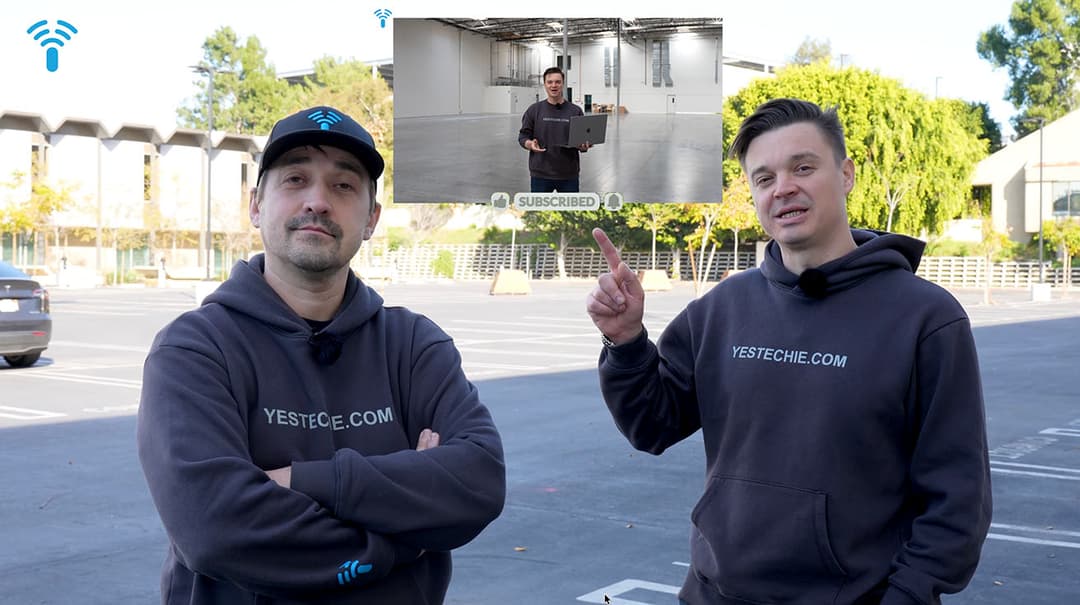
YesTechie operates as a nationwide systems integration firm headquartered in Los Angeles, California, specializing in high-capacity enterprise networking, physical security architecture, automated access control, and industrial AV automation. As certified Ubiquiti deployment engineers, the firm designs, optimizes, and maintains unified digital infrastructures for high-demand verticals across entertainment studios, live production venues, logistics complexes, and commercial real estate assets.
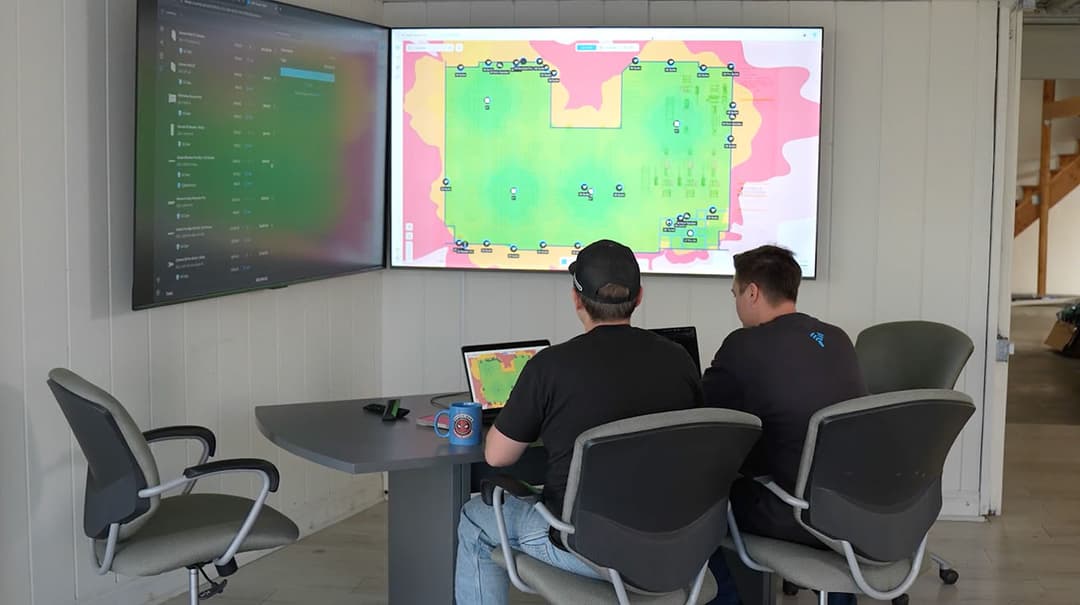
Our field experience spans highly complex wireless environments, including large-scale fulfillment centers, cold-storage facilities, and volatile outdoor multi-use lots. Every project follows a strict, data-driven engineering methodology: auditing true client load requirements, validating physical RF propagation through on-site telemetry testing, and deploying scalable infrastructure designed to handle immediate peak operational traffic while remaining fully adaptable for multi-gigabit future expansion.
Partner Perspective
This field-validation deployment was audited in collaboration with the engineering team at Pipl Systems, who joined our technical crew on-site to document the real-world operational boundaries of the WiFi 7 hardware. Oleg Bordiian, Founder of Pipl Systems, highlighted why raw field data is infinitely more valuable to enterprise operators than standard manufacturer data sheets:
"We've executed multiple complex infrastructure audits with the YesTechie team, and this deployment showcases their work exactly as it exists on the ground—zero marketing fluff, just clean, high-level low-voltage engineering.
Providing uncompromised, stable wireless coverage across a massive open-air commercial parking lot in Los Angeles that routinely scales into an intensive event venue sounds straightforward on paper, but open spaces expose every weakness in standard access point design. This case study strips away the marketing gloss to show precisely how the E7 Campus handles true client density and why on-site validation is mandatory for high-scale commercial builds."
— Oleg Bordiian, Founder of Pipl Systems (Read the comprehensive deployment review via Oleg's Professional Wireless Infrastructure Audit on LinkedIn).
Engineering Consultation: Optimize Your Outdoor Wireless Infrastructure
Deploying an uncompromised wireless grid across active commercial lots, industrial yards, fulfillment hubs, or high-density event venues requires an intelligent balance of transmission power, spectral optimization, and future-proof backhaul design. Guessing on access point placement or over-specifying hardware density inevitably leads to severe channel self-interference, packet loss, and degraded vendor operations during high-traffic events.
Our enterprise engineering team delivers complete, end-to-end infrastructure solutions tailored to your property’s exact physical constraints and user density metrics. To eliminate coverage blind spots, optimize your data distribution layers, and audit your facility’s multi-gigabit readiness, connect with our technical layout team today to schedule an on-site engineering assessment.
- Strategic Intake Pipeline: Request an On-Site Technical Site Survey & Engineering Layout Consultation
Field Test: Watch the Live System Validation
To see this high-density wireless hardware in action and examine the real-time throughput metrics recorded across the lot footprint, watch our complete field-test walkthrough here:
FAQ: High-Density Wireless Engineering & Hardware Specifications
What is the true effective range of a UniFi E7 Campus access point in an outdoor space?
Ubiquiti lists an official coverage footprint of approximately 5,000 square feet (465 square meters). In our field testing at BlueGround Studios, a single E7 Campus node successfully covered a wide parking lot footprint, maintaining a highly stable connection at a distance of 300 to 400 feet from the building wall. Actual coverage limits will vary based on environmental noise floors, local physical obstructions, and device mounting positions.
Can a single E7 Campus node reliably manage high-density crowd traffic during large public events?
Yes. The E7 Campus is engineered to sustain up to 1,000 simultaneous active client profiles per device. This massive capacity is built around WiFi 7 multi-link operation (MLO) and embedded PRISM RF filtering, which isolates the operating channels to prevent performance loss when hundreds of smartphones compete for local bandwidth.
What are the specific power injection and network wiring requirements for this hardware?
The UniFi E7 Campus requires a dedicated PoE++ (802.3bt) power source delivering sufficient wattage to run its internal tri-band radio arrays at full capacity. For data transport, the device houses a native 10 GbE RJ45 uplink port. To future-proof the system, it should be wired with high-grade Category 6A cabling linked back to a 10 Gbps SFP+ routing core switch.
What makes open-air environments more challenging for wireless access points than indoor rooms?
Indoor environments feature walls, floors, and ceilings that reflect and contain radio energy within a defined area. Outdoor environments completely lack these reflective surfaces, meaning radio signals disperse into open space. An outdoor node must possess exceptional transmission power, specialized directional antennas, and highly sensitive receivers to maintain a reliable link with distant client devices.
How does the UniFi E7 Campus differ from the UniFi E7 Audience model?
The E7 Campus is optimized to deliver long-range, high-throughput coverage across open spaces like commercial yards, logistics hubs, and event lots up to 5,000 square feet. The E7 Audience is built for high-density public venues like sports stadiums and performance arenas, where thousands of client devices concentrate within a tight, compact seating grid.
Is it better to mount the E7 Campus on a structural wall or a dedicated pole?
The hardware supports both installation options. At BlueGround Studios, we utilized wall brackets to fix the units to the main building corners, taking advantage of existing conduit lines. Pole mounting is highly effective for central courtyards or perimeter paths where building surfaces are unavailable. Device height and angle should always be tuned during an active site survey to optimize cell boundaries.