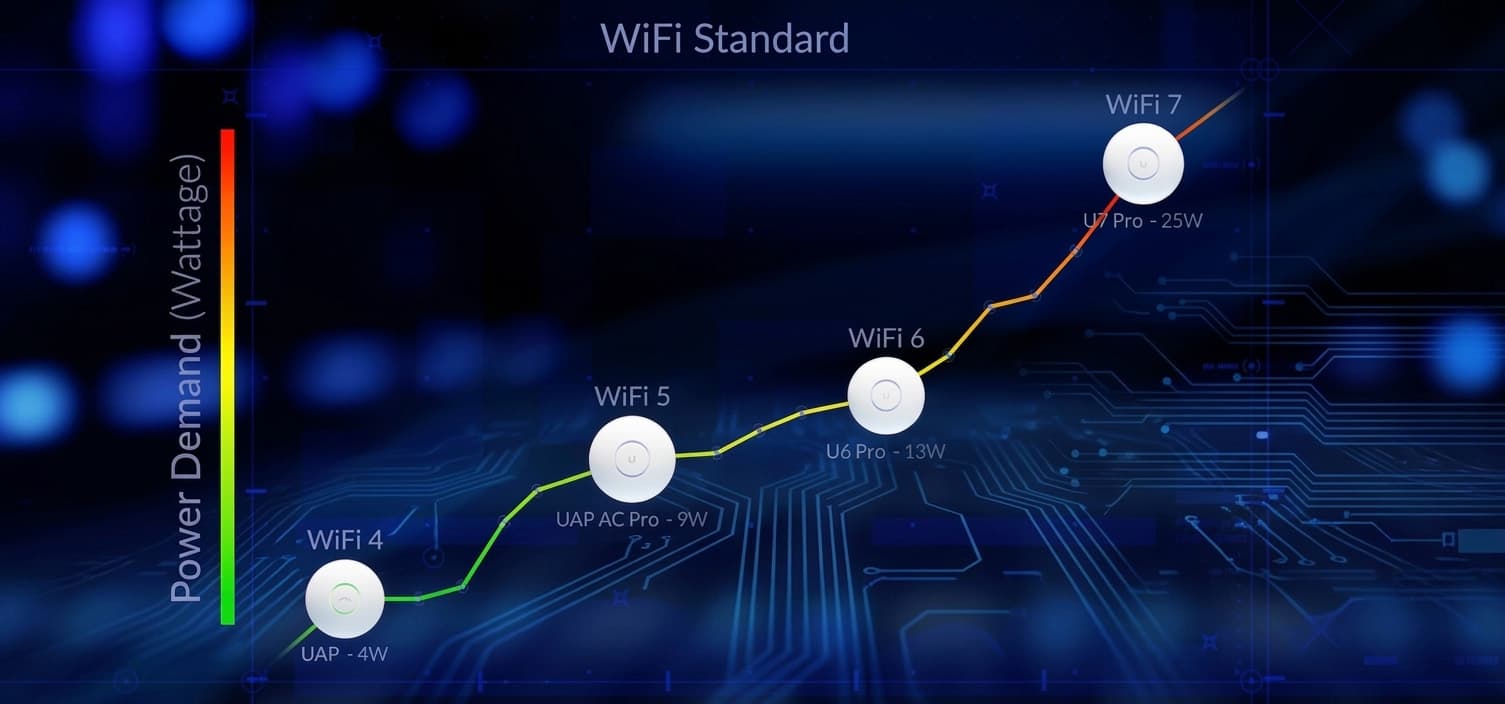
How We Built a 2.5GbE UniFi Wi-Fi 7 Network for a 700K Sq Ft Warehouse in 20 Days
This enterprise case study breaks down the rapid deployment of a subscription-free UniFi Wi-Fi 7 network across a 700,000-square-foot active logistics hub in Ohio. Delivering full operational readiness within a strict 20-day deadline, the architecture links four independent IDF nodes via a dedicated fiber-optic backbone to drive high-density access points over 2.5 GbE uplinks, ensuring uninterrupted barcode scanning coverage.
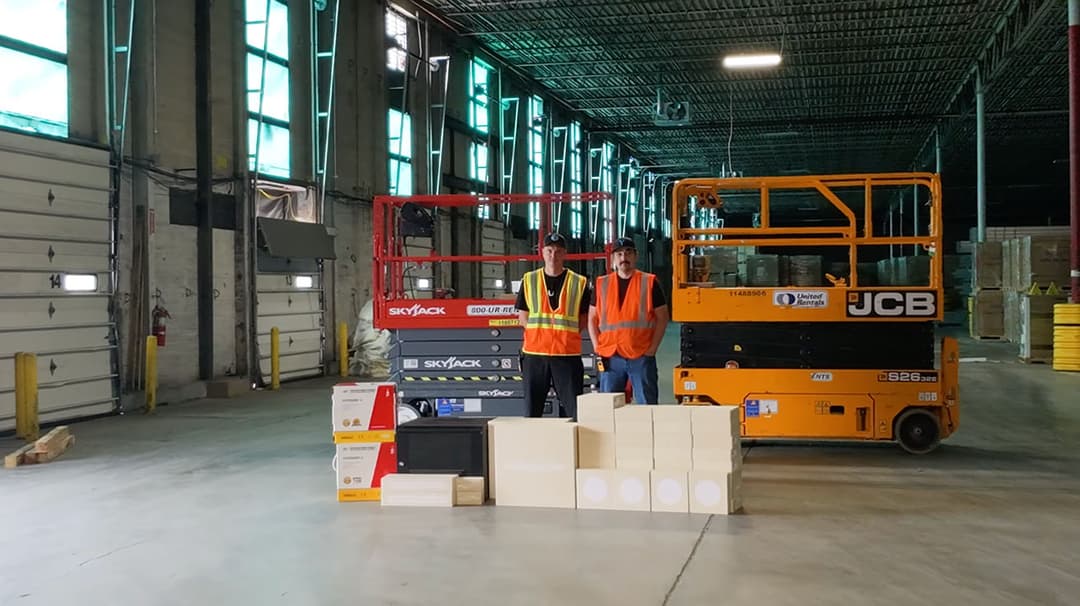
Project Blueprint & Hardware Matrix
- Facility Profile
- Location: Active Logistics Hub, Ohio
- Footprint: 700,000 Square Feet
- Operational Cycle: 24/7 Continuous Supply Chain Operations
- Backbone Infrastructure
- Distribution Nodes: 4 Intermediate Distribution Frames (IDFs)
- Trunk Lines: Heavy-Duty Fiber Optic Cables routed directly to each IDF node
- Power Resilience: Dedicated Uninterruptible Power Supplies (UPS) deployed at every IDF rack
- Core Switching & Wireless Hardware
- Switching Layer: 4 units of
USW Pro Max 48Port Switches - Wireless Access Points: Enterprise
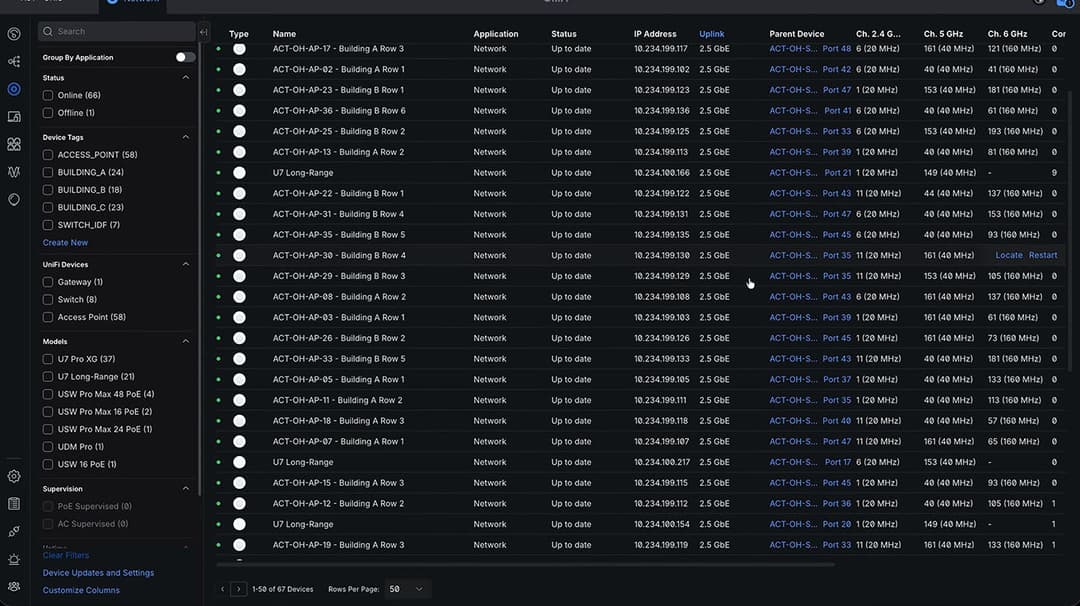
U7 Pro XGAccess Points (Wi-Fi 7 Standard) - Client Link Capacity: Dedicated 2.5 GbE Uplinks per access point
- Switching Layer: 4 units of
- Engineering Software Stack
- Pre-Planning Software: UniFi Designer Tool (Predictive RF Modeling)
- Post-Installation Validation: NetSpot (Comprehensive RF Field Survey)
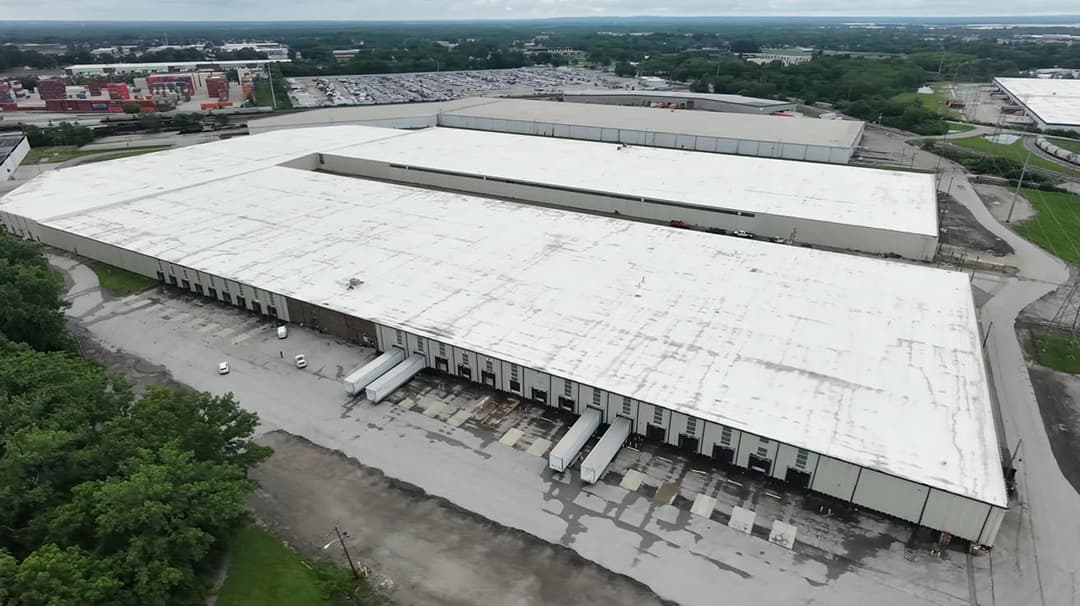
Project Scope: 700,000 Sq Ft Ohio Logistics Hub
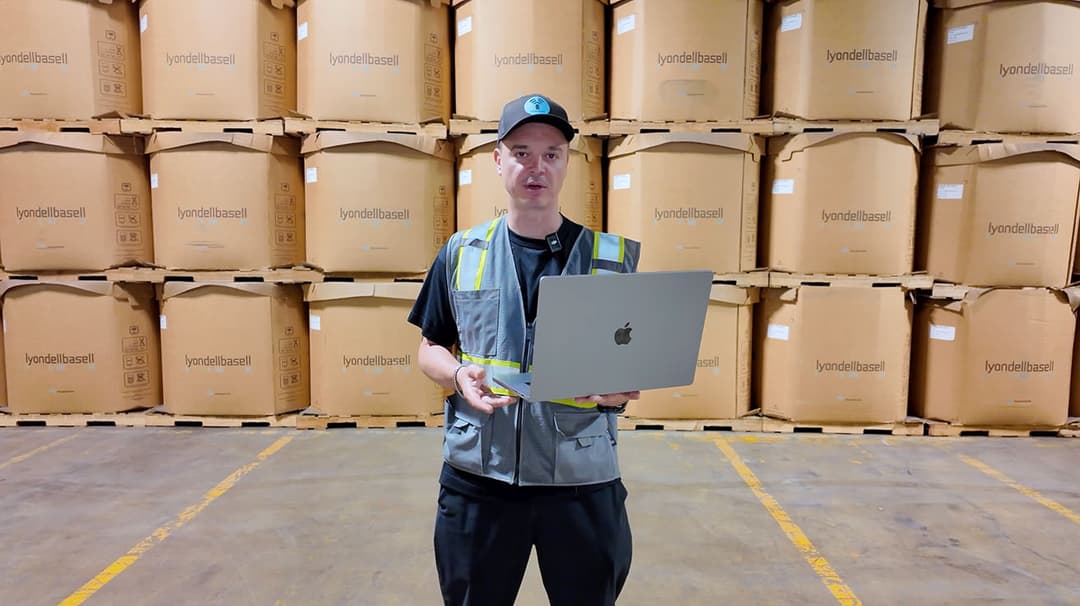
Industrial supply chain facilities require uncompromised wireless network stability to maintain active inventory tracking. In a massive logistics environment, any localized drop in wireless signal disrupts the automated scanning matrix, halting forklift workflows and delaying shipping schedules. This deployment required building a high-capacity enterprise network entirely from scratch to deliver comprehensive Wi-Fi coverage across a 700,000-square-foot logistics hub in Ohio.
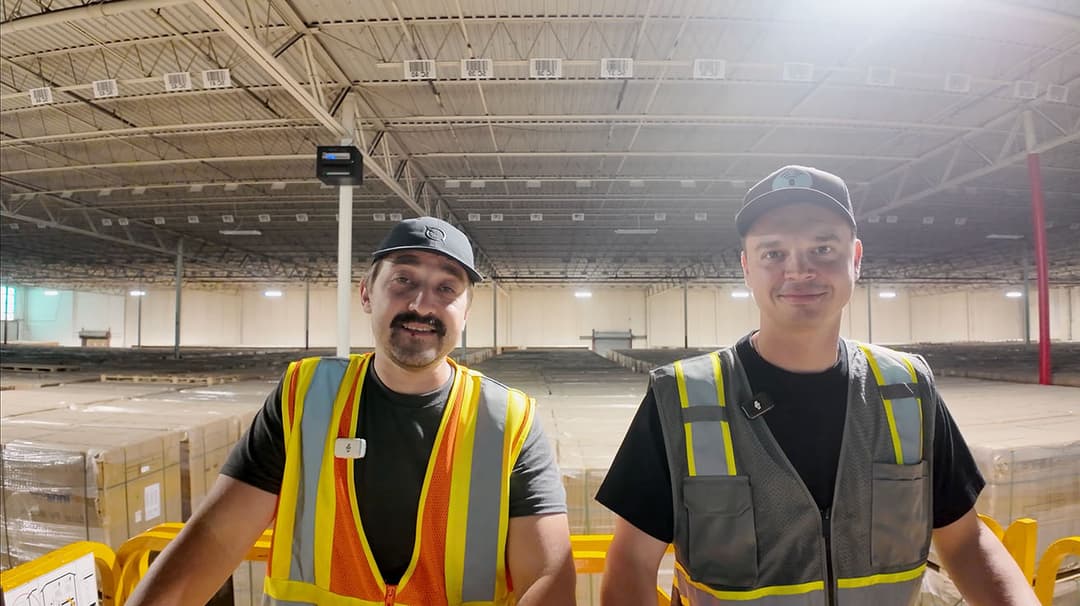
The vast, open-span layout of this facility eliminated structural barriers, allowing our team to leverage unobstructed lines of sight to optimize signal propagation and channel management across the massive 700,000-square-foot footprint. Our engineering group draws on extensive field experience with large-scale industrial spaces, such as our recent commercial security camera installation for a 77,000 sq ft warehouse facility, where multi-node alignment was critical to eliminate blind spots.
For this Ohio facility, the primary operational directive was to guarantee strong, reliable wireless coverage for a fleet of mobile barcode scanners operating throughout the entire building footprint, executed under a strict 20-day turnaround window.
Network Infrastructure: USW Pro Max Switches & U7 Pro XG APs
To feed high-speed data across nearly a million square feet without signal degradation, our low-voltage technicians rejected standard multi-hop copper runs and deployed a dedicated fiber-optic backbone. The facility's infrastructure layout centers on four strategically positioned Intermediate Distribution Frames (IDFs) linked back to the main equipment room via high-bandwidth fiber optic trunk lines.
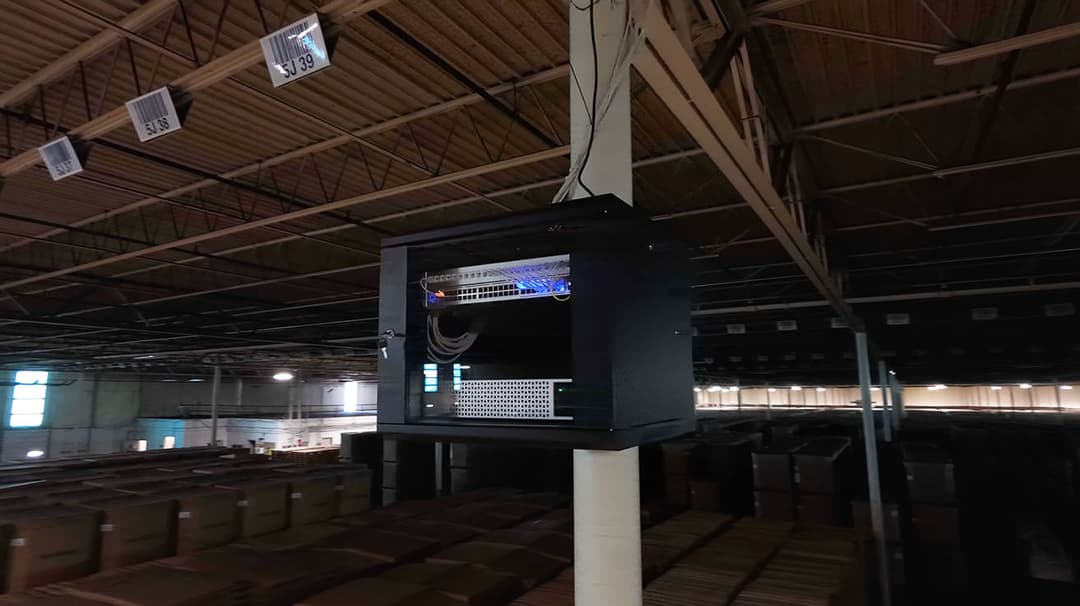
The core routing and connection distribution layers are built around a robust managed network infrastructure configuration consisting of the following key assets:
- USW Pro Max 48-Port Switches
- Deployment: One 48-port enterprise switch populated inside each of the four remote IDF enclosures.
- Role: Delivers high-output Power over Ethernet (PoE) budget and high-speed data routing straight to the ceiling joists.
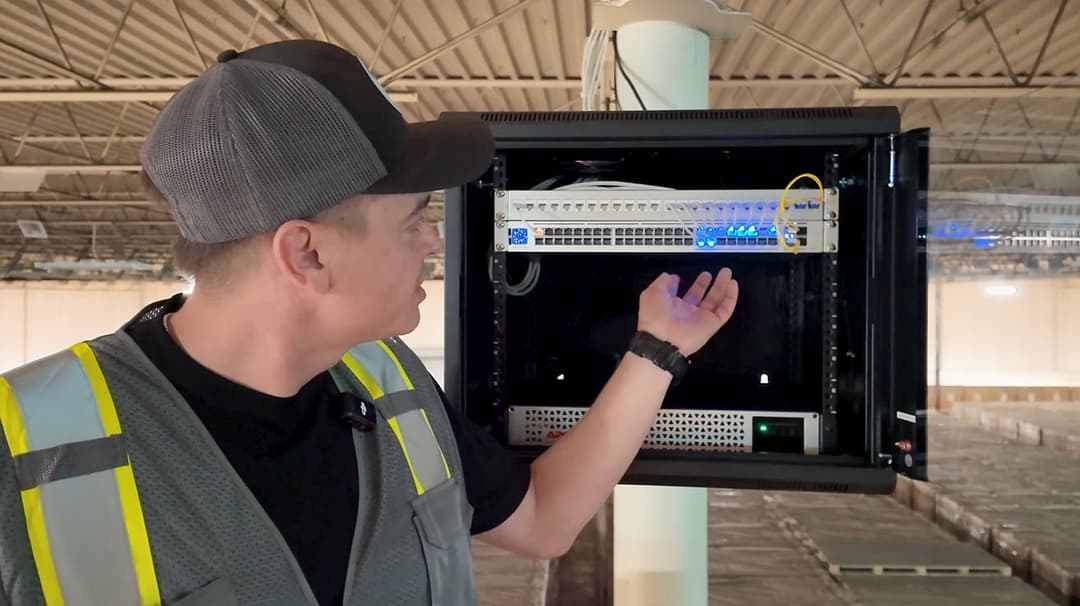
- UniFi U7 Pro XG Access Points
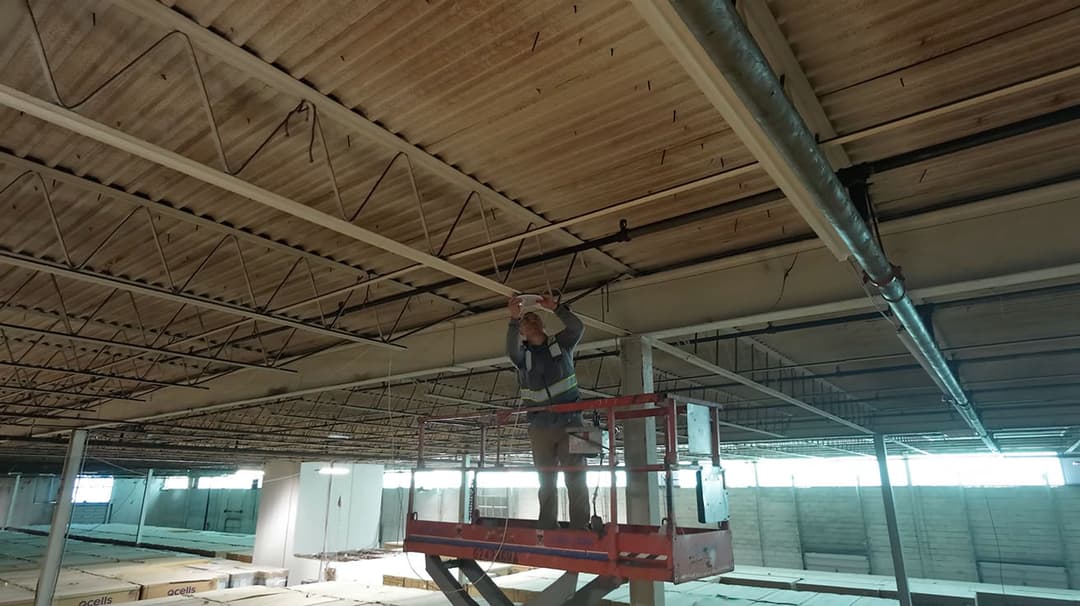
- Deployment: Distributed across high-clearance warehouse bays and attached administrative office sectors.
- Role: Drives multi-band Wi-Fi 7 connectivity to accommodate hundreds of concurrent automated client devices.
- 2.5 GbE Uplink Architecture
- Deployment: Every single
U7 Pro XGnode terminates directly into a high-bandwidth 2.5 GbE switch port. - Role: Eliminates standard 1-Gigabit data bottlenecks, allowing the Wi-Fi 7 channels to utilize full wireless throughput capacity.
- Deployment: Every single
- Rack-Mounted UPS Units
- Deployment: Integrated directly into the base of each individual IDF rack assembly.
- Role: Secures active power failover capacity, ensuring the switches and access nodes stay running during local utility grid fluctuations.
By standardizing on a single hardware ecosystem, the logistics hub benefits from an integrated management interface with zero ongoing licensing fees or software subscription costs. This architecture delivers predictable ownership metrics matching our standard professional WiFi installation parameters.
Installation Challenges: 24/7 Operations & Drone Cable Fishing
Executing a comprehensive hardware rollout inside an active, 24/7 logistics hub introduces significant spatial and environmental hurdles. The facility could not pause its supply chain fulfillment operations, meaning our low-voltage technicians had to coordinate their movements around a high-volume fleet of forklifts moving through the active travel lanes continuously.
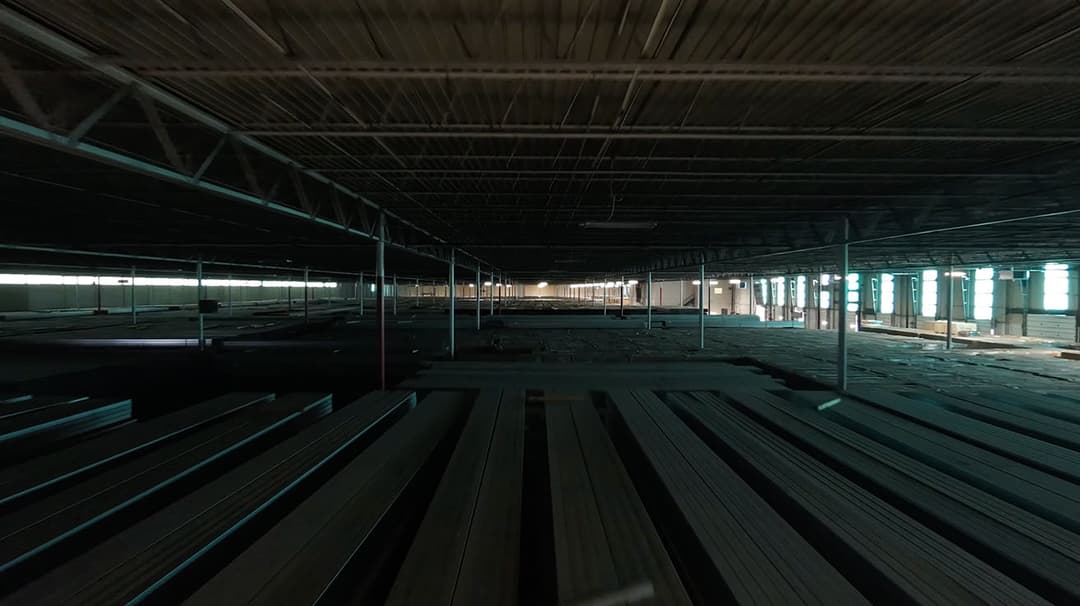
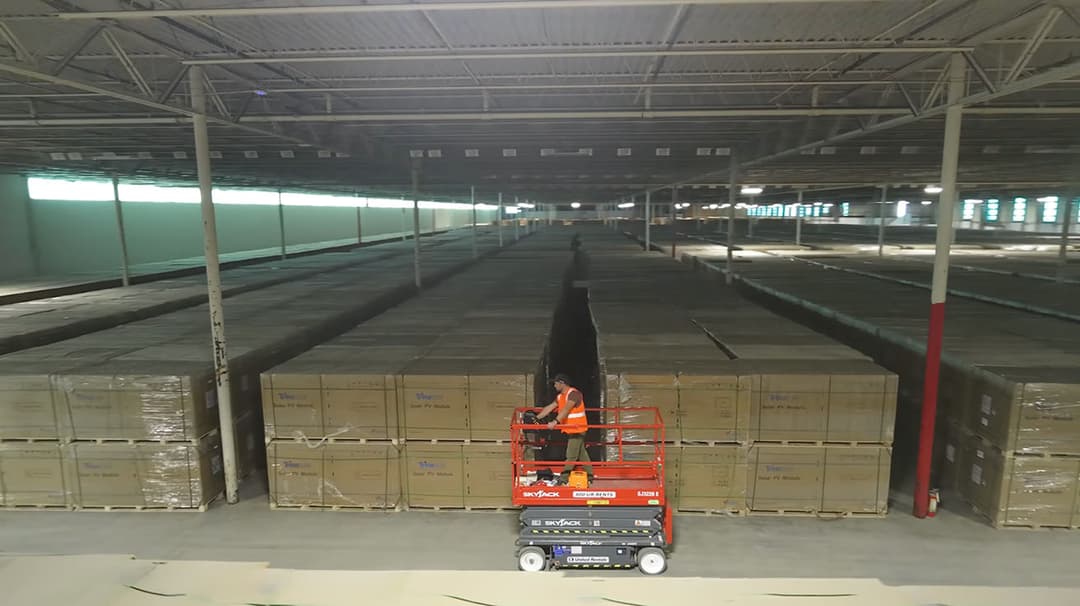
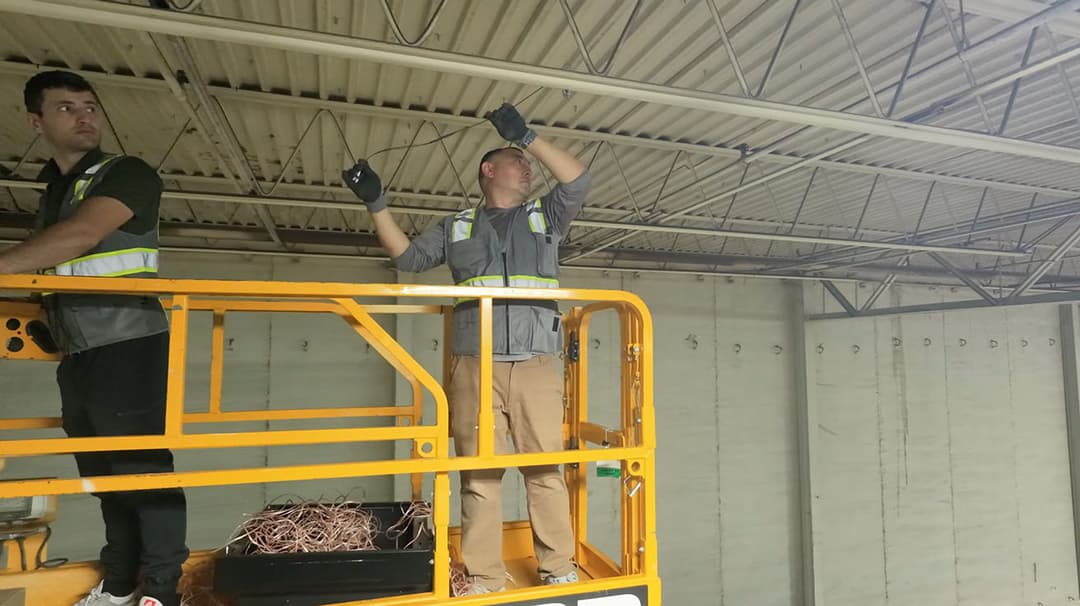
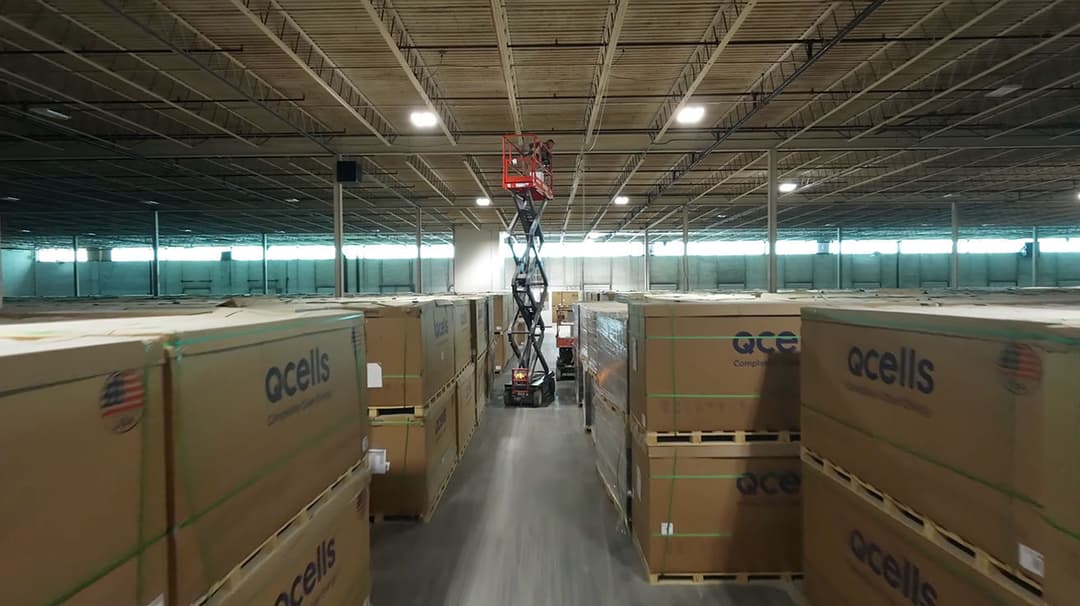
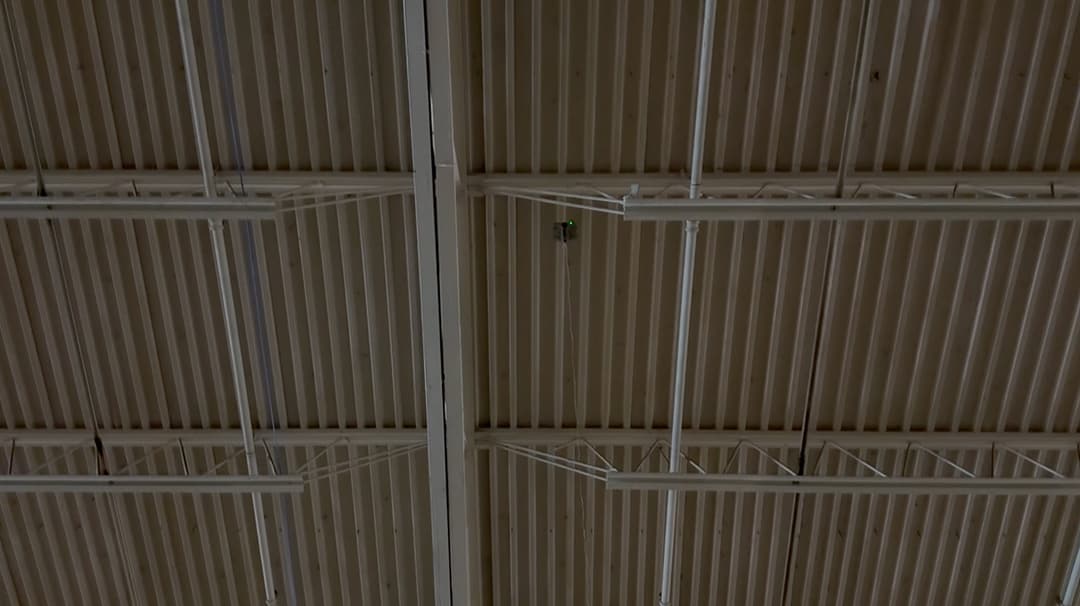
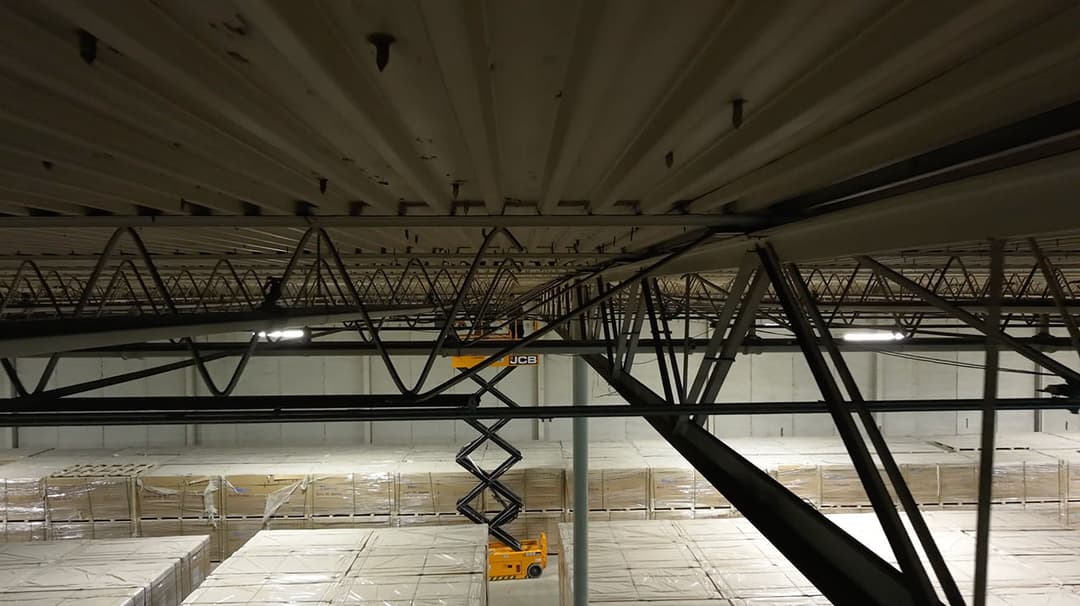
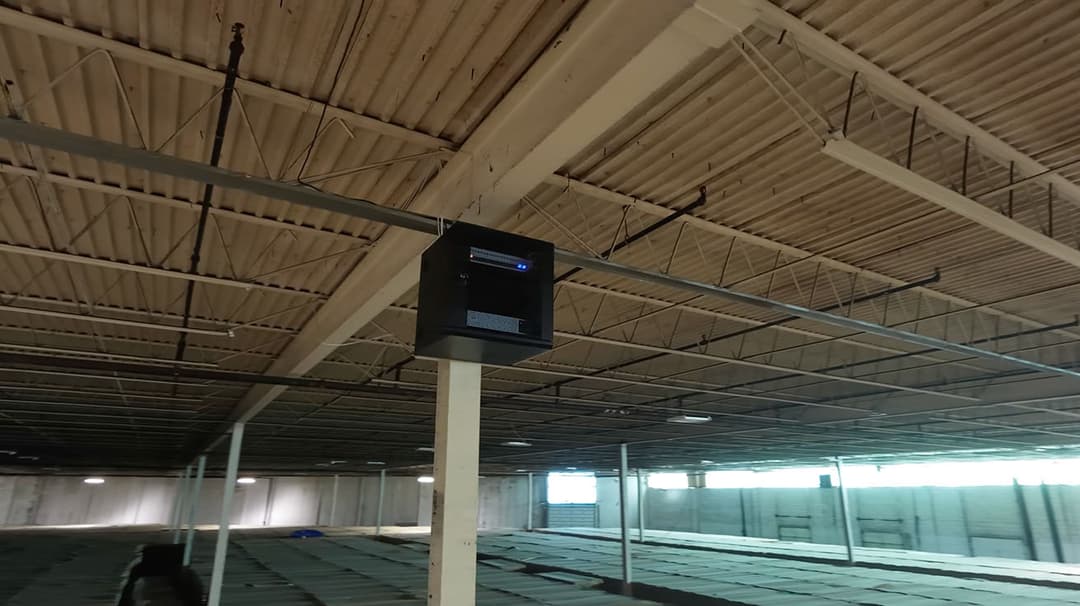
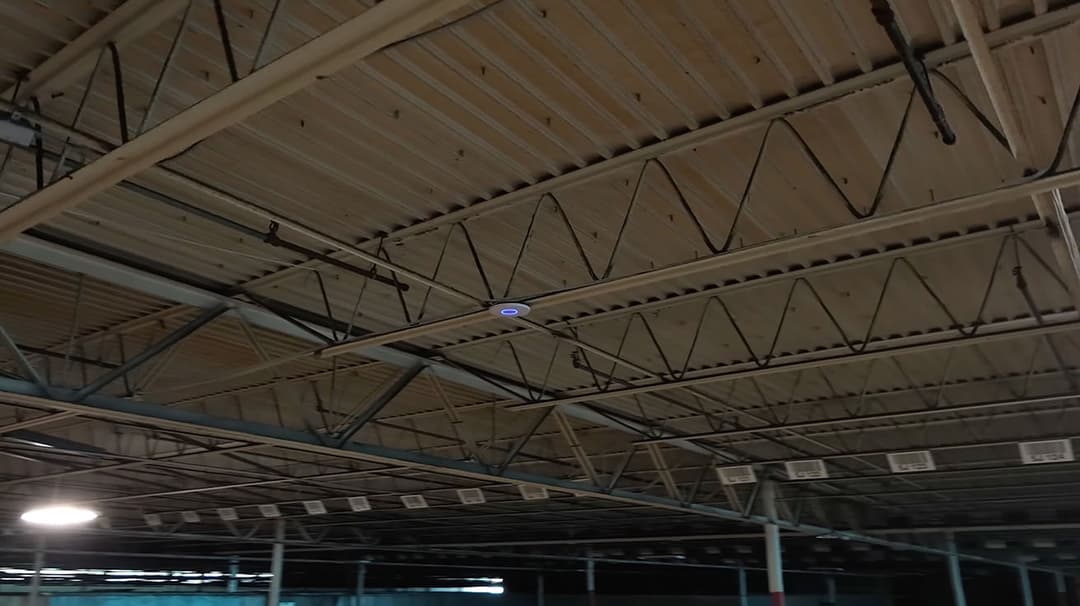
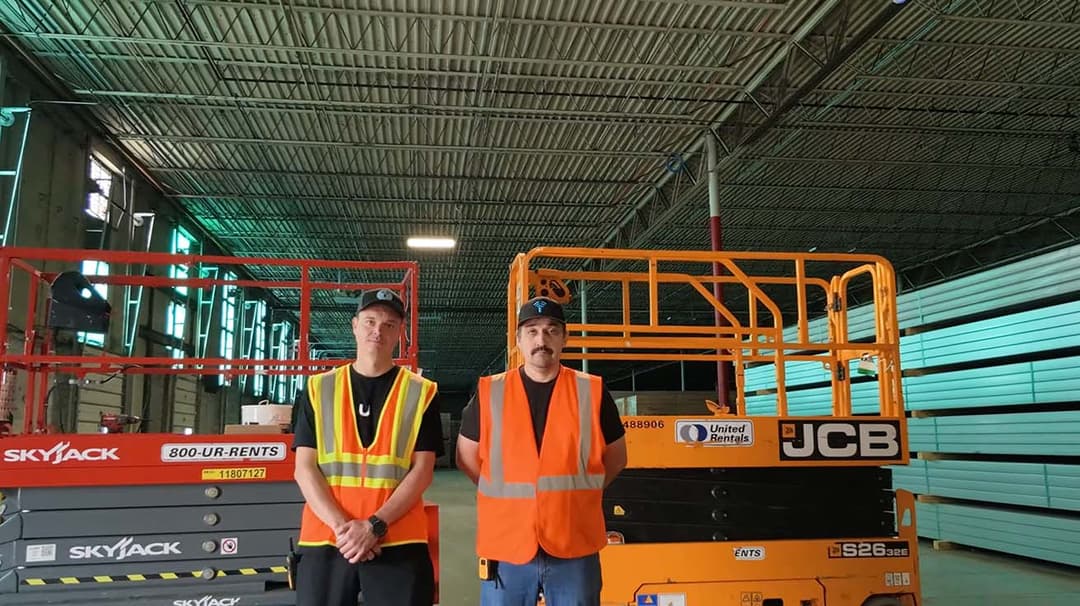
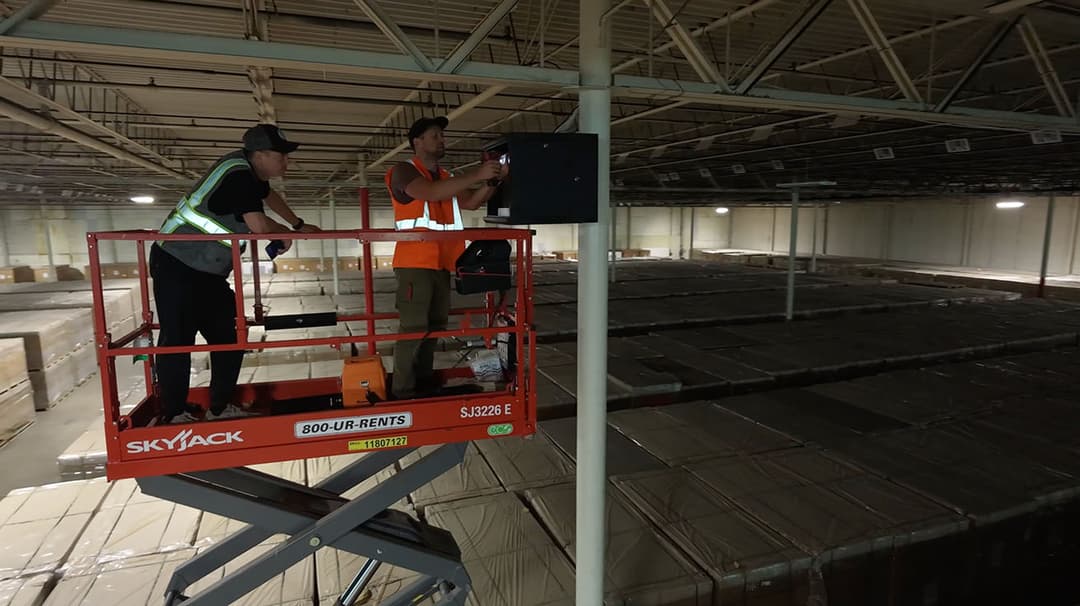
Beyond the logistical traffic, specific deep-storage warehouse sectors featured high-clearance structural blocks that were inaccessible via traditional scissor lifts or manual push rods. To bypass these architectural barriers with maximum efficiency, our field crew deployed an advanced tactical workaround: using an aerial drone to fish cables across the elevated roof trusses.
The drone was navigated safely through the ceiling ironwork to pull a lightweight pilot line across difficult-to-reach bays. Once the pilot line was secured on the opposite end, our technicians used it to pull the heavy CAT6A lines through the structural layout. This strategy eliminated the need to block active forklift lanes below, keeping the installation timeline moving forward safely.
This adaptive approach to industrial layout constraints parallels our engineering solutions for climate-controlled environments, such as our turnkey wireless network integration for cold storage facilities, where dense physical barriers require specialized routing methods.
Pre-Planning & Validation: UniFi Design Center & NetSpot Survey
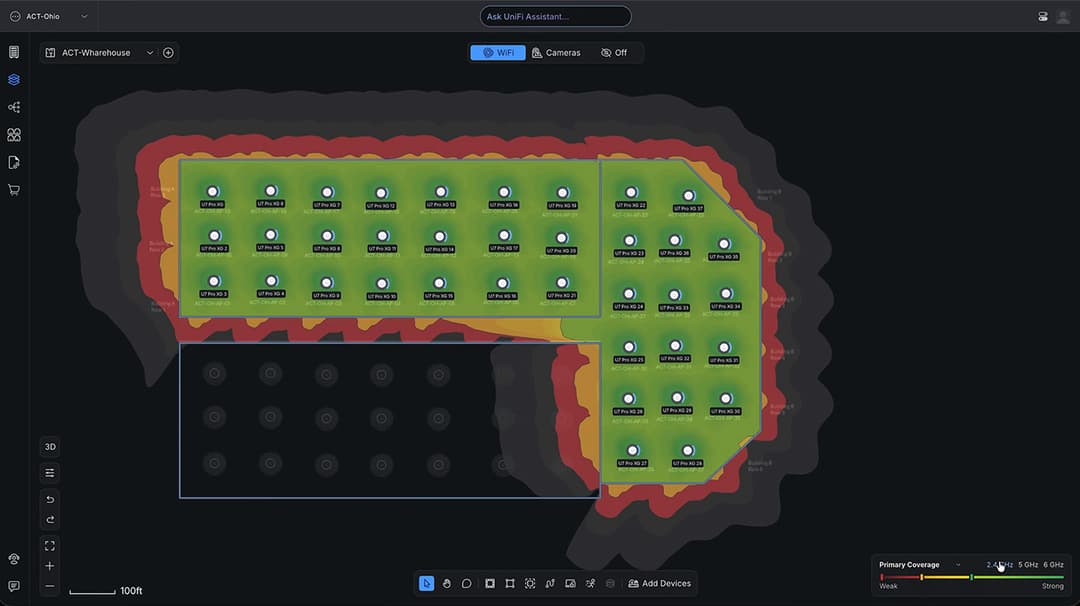
With a strict project deadline, on-site guesswork or miscalculated equipment orders would cause immediate project delays. Our team mitigated these risks by executing a two-stage RF validation process to confirm complete signal coverage before and after the physical installation phase.
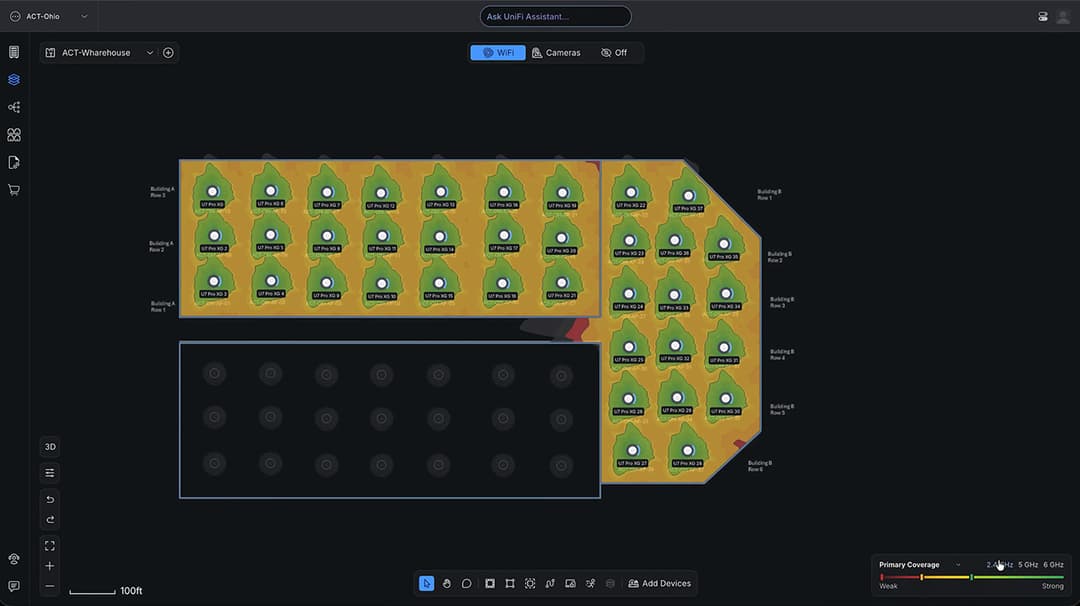
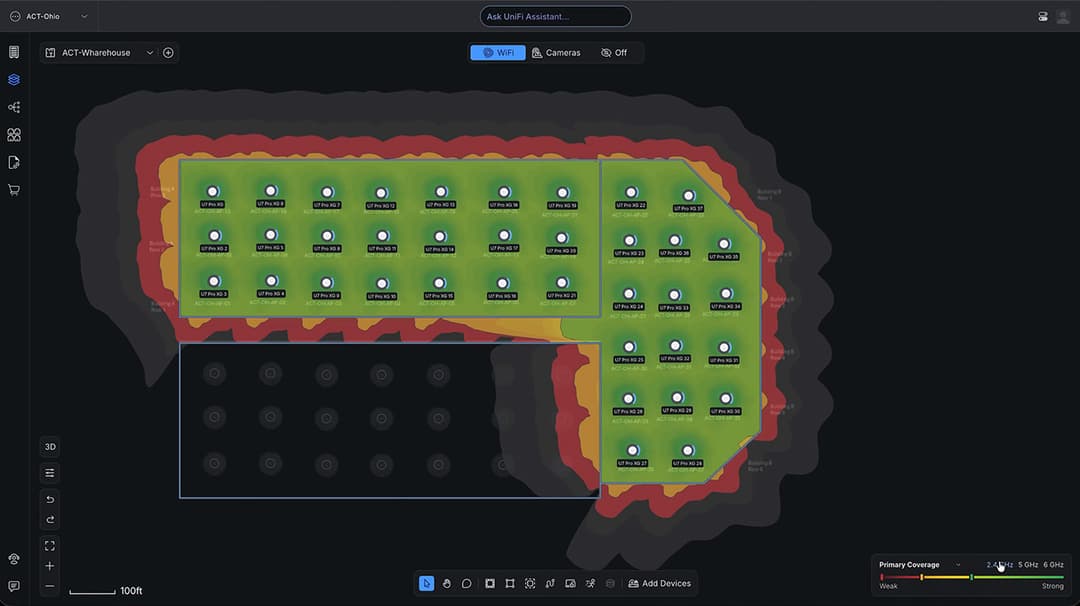
1. Predictive RF Modeling (UniFi Designer Tool)
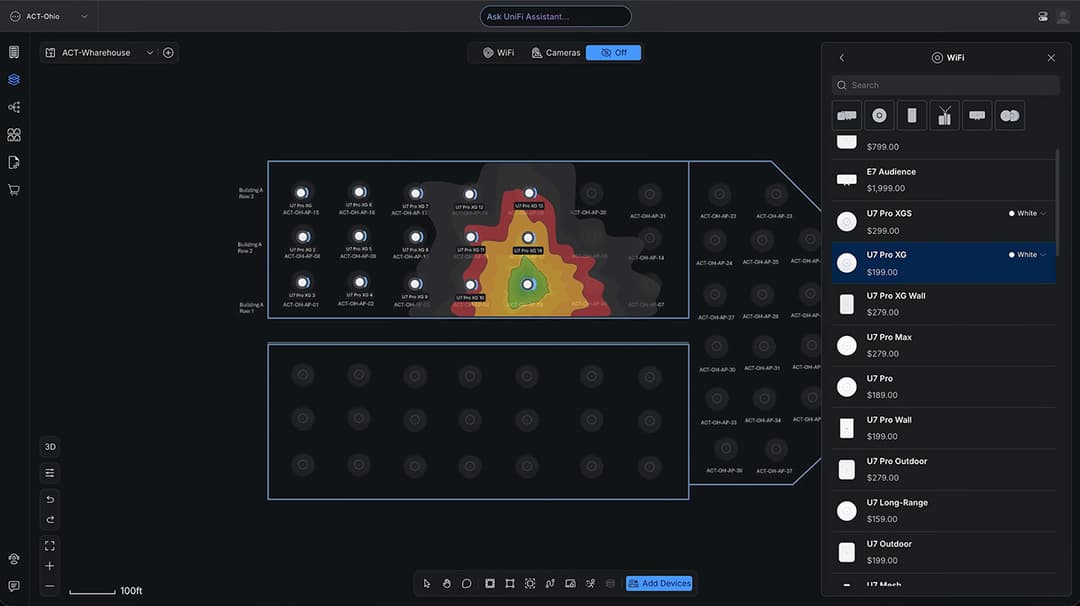
Predictive modeling platforms, such as UniFi Design Center, allow network engineers to construct a digital twin of the facility before purchasing hardware. By inputting accurate wall materials, ceiling heights, and open-span dimensions, the software simulates how radio waves will behave on site. This prevents under-ordering equipment (which leaves blind spots) or over-purchasing devices (which causes signal interference and wastes budget), ensuring a cost-effective, precise deployment.
2. Physical RF Survey (NetSpot Validation)
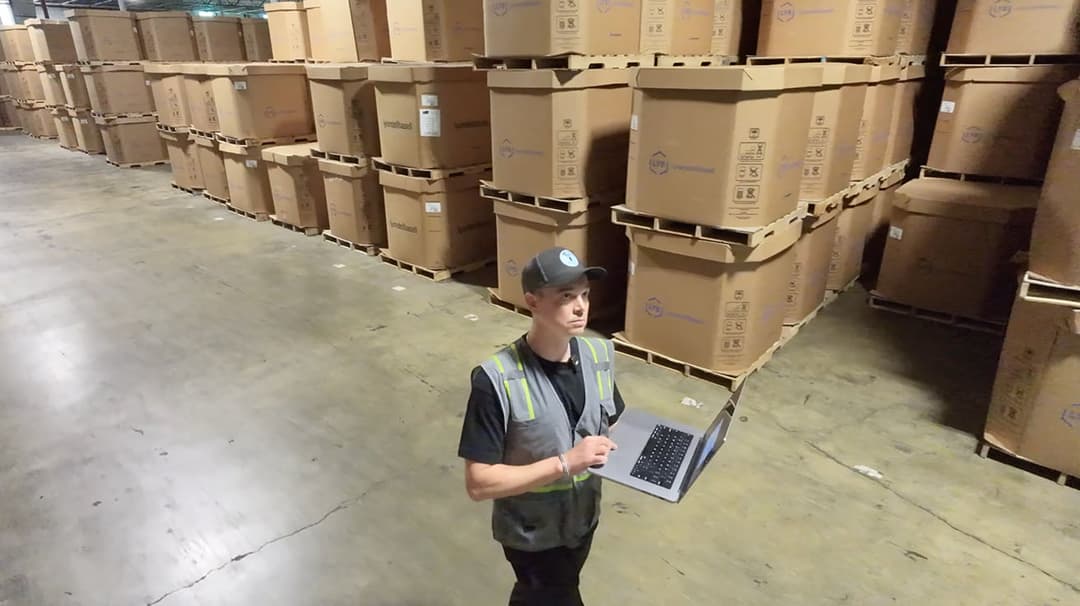
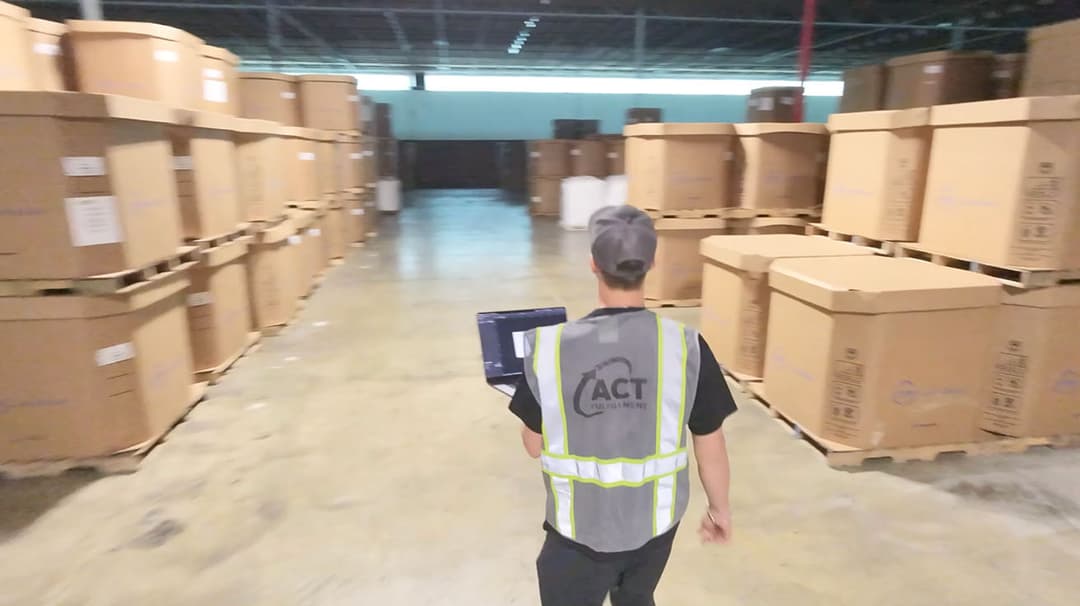
Once the low-voltage lines were terminated and the hardware was powered up, we performed a thorough physical RF site survey using NetSpot diagnostics software. Our technicians walked the entire 700,000-square-foot floor area with data logging tools, measuring signal-to-noise ratios (SNR), roaming handoff latencies, and signal boundaries.
The resulting heatmap verified that our predictive model was completely accurate, confirming stable, high-throughput wireless coverage across all inventory bays. This methodical approach to high-density signal calibration mirrors the design strategies we used during our high-density network deployment for production studios, where zero-latency connectivity is the primary benchmark.
Final Summary: Delivering a Massive UniFi Network in 20 Days
The Ohio logistics network modernization project was successfully completed and signed off ahead of the client's June 1st operational launch window. The entire timeline - spanning intake consultation, predictive modeling, hardware procurement, cross-country transport, physical installation, and final RF certification - was executed in just 20 days total.
Our on-site field team completed the physical fiber runs, rack building, and access point mounting in only 5 days, minimizing our on-site footprint and preventing operational disruptions for the client's team. The client’s management group explicitly noted that delivering a fully operational, enterprise-grade network of this scale within such a tight timeframe was highly impressive.
Whether upgrading a single distribution depot or building out multi-state industrial infrastructure, our low-voltage teams deliver fast, reliable results across the country.
About YesTechie
YesTechie operates as a nationwide Certified Ubiquiti UniFi Professional Integrator headquartered in Los Angeles, California. Founded by Anton Kuznetsov and Vladimir Chasovskikh, our engineering teams build on more than 20 years of hands-on experience in networking, security systems, and complex IT projects. Moving away from static playbooks, we approach physical security and IT infrastructure from first principles. Leveraging this core engineering mindset, we design, deploy, and audit unified network ecosystems that eliminate ongoing software seat fees while ensuring absolute data ownership and predictable, long-term performance under load.

Holding an official C-7 Low Voltage Systems Contractor license (CSLB #1148851), YesTechie provides structured engineering and rapid deployment capabilities on a nationwide scale. While headquartered in California, our mobile field crews deliver turnkey hardware rollouts across multiple states - including recent enterprise deployments in Ohio, Texas, Florida, Illinois, and Pennsylvania. From complex multi-site business modernizations to high-clearance 700,000-square-foot industrial layouts, we align advanced hardware configurations with strict municipal code compliance. Explore our full integration capabilities by browsing our complete commercial low-voltage services index.
Engineering Consultation: Upgrade Your Network & Security Infrastructure
Managing multi-use industrial warehouses, manufacturing facilities, or logistics hubs requires a resilient network architecture that handles heavy device data without creating fragile workarounds. Miscalculating fiber-optic link budgets, over-allocating switch port power, or improperly mapping RF signal boundaries leads to immediate operational dropouts and communication failures during peak supply chain hours.

Our technical group provides complete, end-to-end blueprinting, project procurement, and physical low-voltage integration services tailored to your facility's exact layout constraints. To eliminate wireless blind spots, optimize your multi-gigabit routing backend, and audit your property's deployment readiness, connect with our layout team today to schedule a comprehensive technical site survey.
- Strategic Intake Portal: Request a Professional On-Site Security & Network Layout Assessment
Field Tour: Watch the Full Wi-Fi 7 Installation Video
To watch our low-voltage field technicians build out the four IDF racks, observe the aerial drone cable fishing maneuvers across the ceiling trusses, and see the final NetSpot performance validation on site in Ohio, view our complete field video here:
FAQ: Industrial Wi-Fi 7 Engineering & Network Architecture
Why is the Wi-Fi 7 (802.11be) standard uniquely suited for large logistics warehouses?
Wi-Fi 7 introduces Multi-Link Operation (MLO), allowing compatible devices to open concurrent data streams across multiple frequency bands (2.4 GHz, 5 GHz, and 6 GHz). In an industrial warehouse, this helps protect against signal blockage caused by heavy metal shelving. If a forklift scanner's line-of-sight to a 5 GHz channel is blocked by a pallet of inventory, the device instantly maintains its connection via the 2.4 GHz or 6 GHz band without dropping a single data packet.
What is the structural difference between an MDF and an IDF in a warehouse network layout?
The Main Distribution Frame (MDF) functions as the central point of entry for the property's primary internet connection and hosts the core routing engines. An Intermediate Distribution Frame (IDF) serves as a localized satellite rack positioned closer to the edge devices. Because copper Ethernet cables have a strict length limit of 328 feet (100 meters), deploying four separate IDFs connected via fiber optics allows us to distribute access points across all 700,000 square feet without signal loss.
How do 2.5 GbE ports on the USW Pro Max switch improve Wi-Fi 7 performance?
Traditional enterprise network switches utilize standard 1-Gigabit (1GbE) connection ports. Because a Wi-Fi 7 access point like the U7 Pro XG can handle aggregate wireless traffic well exceeding 1 Gbps from hundreds of active clients, a standard 1GbE link becomes a major system bottleneck. Connecting these points over dedicated 2.5 GbE links ensures the switch can ingest full wireless data loads without bottlenecks or dropped packets.
What are the primary hazards when installing low-voltage wiring in a 24/7 industrial facility?
The primary challenges involve height management, active heavy machinery traffic, and strict adherence to workplace safety regulations (OSHA). Operating scissor lifts alongside active forklifts requires clear communication, proper safety signage, and dedicated spotters. In hard-to-reach ceiling joists, utilizing alternative methods like aerial drones to route pilot lines removes technicians from hazardous positions and keeps warehouse traffic moving safely below.
How does predictive RF software help reduce the cost of an enterprise wireless installation?
Predictive modeling platforms, such as the UniFi designer tool, allow network engineers to construct a digital twin of the facility before purchasing hardware. By inputting accurate wall materials, ceiling heights, and shelving dimensions, the software simulates how radio waves will behave on site. This prevents under-ordering equipment (which leaves blind spots) or over-purchasing devices (which causes signal interference and wastes budget), ensuring a cost-effective, precise deployment.